Ejit

The Market Garden App

How the Market Garden App Started

In order to empower women in the informal sector for social and economic self –reliance, the Institute for Social Transformation (IST), a women’s rights NGO in Uganda built capacity of over 10,000 market women from markets across the country in business and financial literacy.

Despite this, the market women entrepreneurs still encountered challenges and competition from mobile vendors, and an emergency of the second layer of middle men who brokerage individual/personal house hold shopping/small and medium sized enterprises shopping and make more profit.

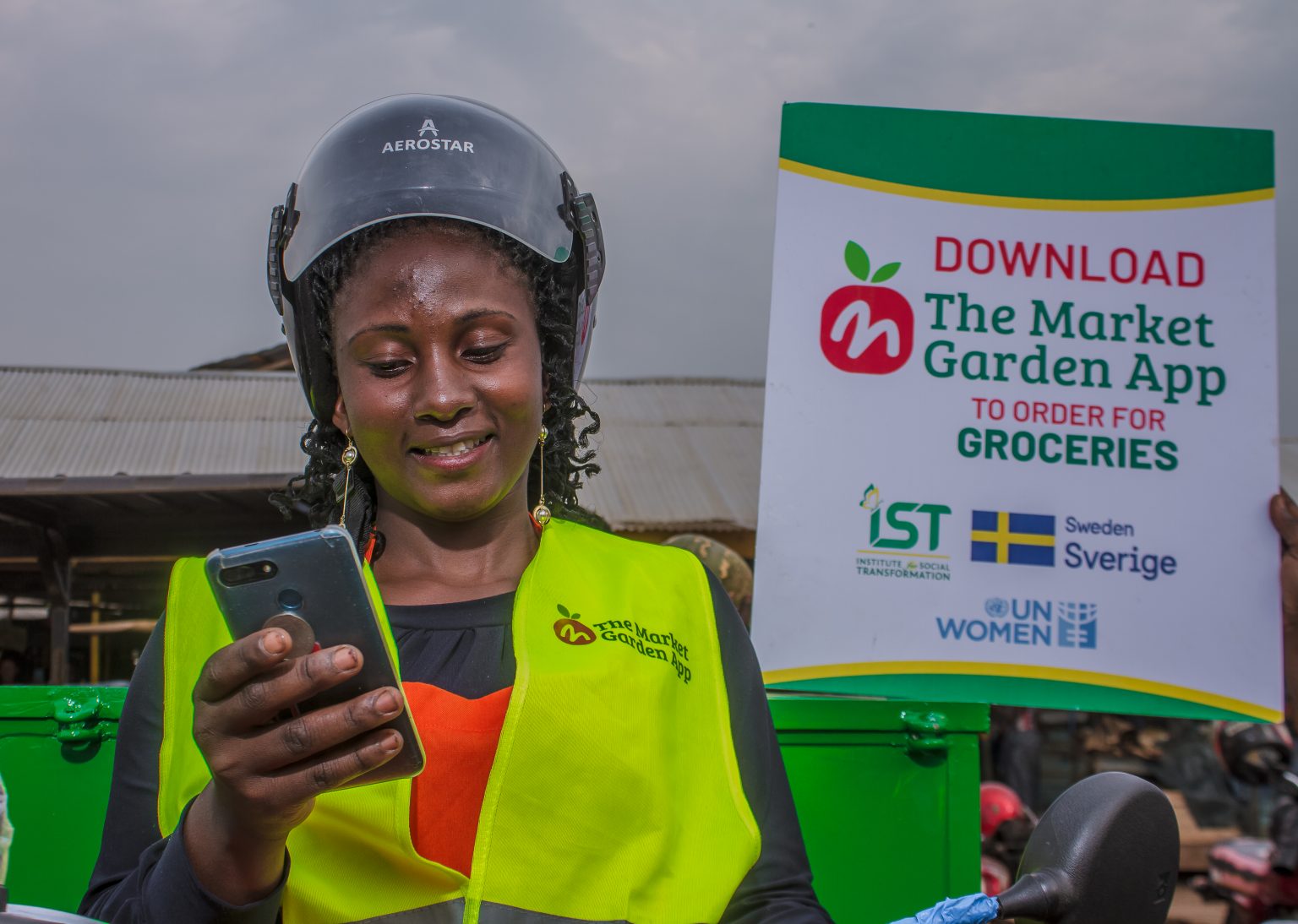
In December 2018, IST with support from UN Women and the Embassy of Sweden developed and launched the Market Garden App, an online sales platform that creates convenience for people to shop for groceries anytime, anywhere using their smartphones.

The Market Garden App went through several test runs in 2019 and was finally open for public use in March 2020. Over 1,500 orders have been processed and delivered. The App is operational in 12 markets in Kampala & Wakiso. There are over 500 women enrolled on the App. The App currently has over 1000 downloads and can be downloaded both on Google Play Store and the Apple App Store

How the App Supports Women in Markets.

Having started operations at the beginning the lockdown in Uganda, the Market Garden App has enabled the market women to rise above the effect of COVID 19 on their businesses.

The App has enabled market women in Kampala to do businesses beyond their stalls. They are able to sell their products online to virtual customers and this has led to a significant increase in their income.

The App has over 120 products which are mostly sold by the market women.

Nevertheless, there are still challenges being faced by the women especially low literacy levels and little or no access to affordable smartphones or data bundles for those with smartphones.

READ MORE
Ejit

Cooperatives, Skilling & Revolving Fund

We have built strong cooperatives with market women in Busia, Iganga, Kampala, Wakiso, Gulu, Arua and Pader with a focus on mobilization, formation, training in co-operative formation and management, conflict management and group dynamics and mentorship in the best business practices and leadership participation for market women. Eight (8) Cooperatives have so far been formed in the 18 markets of operation and the program is yet to be rolled out to the other markets.

Under this programme, we aim to transform the working conditions of women in the informal sector operating in selected markets. We invest substantially in building coalitions and networks for women working in the informal sector, particularly market women to strengthen their positions and to give them a platform to address policy makers and local authorities collectively.

Through the Cooperative programme, the groups have been equipped with different skills; craft making, liquid soap making, briquette making, urban farming and food processing/value addition which is still on a smaller scale. The Institute also capacitates the cooperative groups with a revolving fund which is given at affordable interest rates. This fund has been used by the different groups to grow businesses but has also helped group members to network socially and emotionally. In some markets, the cooperatives are used for handling GBV cases and cases of sexual harassment.

READ MORE
Ejit

Functional Adult Literacy

We run a needs-based adult literacy class for market communities in Kampala and Wakiso districts in Uganda. The Adult literacy classes are conducted focusing on addressing the needs, problems, and the dreams of market women and therefore help them to learn reading, writing, counting, how to care about their health, knowing about their human rights and the laws governing them as citizens of Uganda.

The classes are conducted in both English and Luganda depending on the levels if literacy. The Adult literacy lessons conducted have not only built the ability to read, write and count but also strengthened the confidence for market women and men to speak through different platforms.

Because of these classes, IST has so far graduated a total number of 88 market women and 2 men from level 1 and level 2 of adult literacy from the three markets of Nakawa, Kalerwe Freedom and Bivamuntuuyo under the Theme “Adult literacy for improved business management”.

READ MORE
Ejit

Laws, Policies & Regulation

The informal sector where markets lie operates under the shadow of non-clarified and gender irresponsive law; the Market Act 1942. The governance structures, infrastructure, services, facilities, regulations, mechanisms of taxation, and redress are much wanting. This has crippled the development interventions directed to the informal sector of the markets operations that is highly comprised of women. The old Act escalates women’s discrimination and abuse in market spaces.

We developed Gender Responsive Guidelines to promote clear referral pathways for violence free markets and safety for women and girls were developed and adopted by markets.

IST continues to organize to influence policy and inclusion for women in markets. We have held a series of multi-level advocacy and accountability dialogues with key stakeholders who include members of parliament, line ministries, local government, market leadership and civil society players aimed at the repeal of the Market Act 1942 and implementation of the gender responsive guidelines/ policies related to the informal sector.

IST has progressed in steering the efforts to influence the repeal of the old Markets Act of 1942. Being a highly contentious Bill, a lot of advocacy and consultations are still needed to ensure it is repealed and enacted into law.

READ MORE