News

The 7th Annual National Women Entrepreneurs Symposium & Youth Summit 2025

The 7th Annual National Women Entrepreneurs Symposium & Youth Summit 2025, held in Kampala on November 18th under the theme “Centering Women and Youth Entrepreneurs for Climate-Resilient and Sustainable Economies,” that was officiated by Yafesi Ogwang, the Assistant Commissioner Ministry of Agriculture addressed the critical national challenge posed by climate change which threatens a potential 3.1% loss in GDP by 2050 and the urgent need to empower the women and youth who form the backbone of the informal economy.

The symposium established that these groups are disproportionately impacted by escalating environmental shocks, yet they possess the inherent capacity to drive transformation through grassroots innovation. Key innovations highlighted included the adoption of agroecology to build soil health and resilience against drought, the use of Black Soldier Fly farming to convert market waste into valuable inputs, and the increased uptake of clean energy solutions. The discussions focused heavily on transitioning these successful local practices into scaled, formal enterprises, recognizing that the lack of access to finance, technology, and formal market registration remains the primary obstacle to achieving full climate resilience.

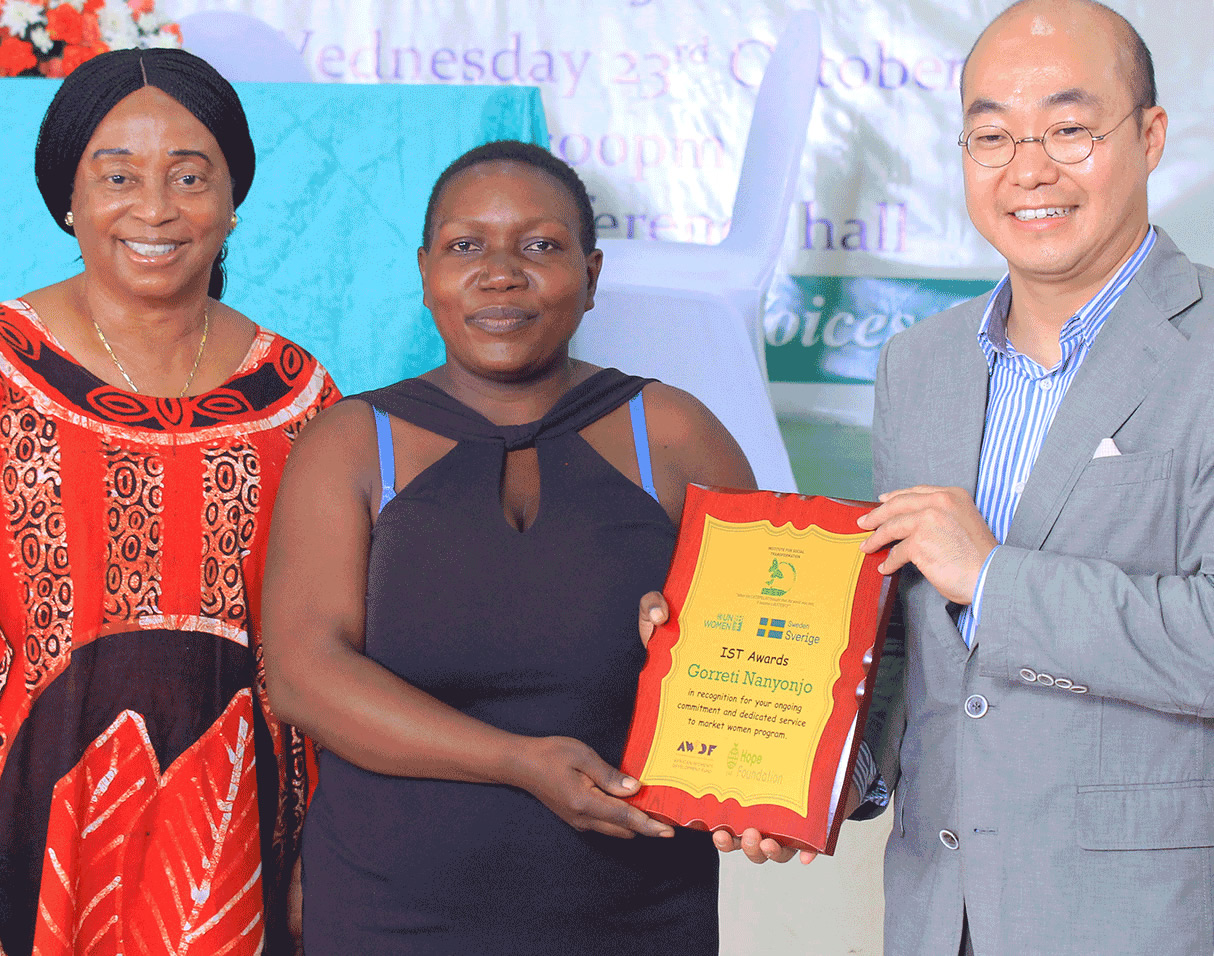
Figure 2. L-R The Executive Director Korea Hope Foundation, LEE Sangjoon, the Assistant Commissioner Ministry of Agriculture Yafesi Ogwang( Chief Guest), the Chief Executive Officer IST, Wagubi Moureen, the Programme Specialist – Women, Peace and Security, Natasha Butorac, the Chief of International Cooperation Team 2 KHF , Emmanuella, Hyeyoon Jung and the Peace Building Lead, Women’s International Peace Centre, Diana Oroma. Photo taken: 18th November, 2025 by The IST Team.

A significant focus of the summit was on the strategic integration of women and youth into both economic and governance frameworks to achieve a just transition. Government and development partners reaffirmed their commitment to leveraging national policies, such as the new Markets Act and the forthcoming National Development Plan (NDP) IV, to support these entrepreneurs. Specific policy advancements included the integration of climate-smart agriculture into the Parish Development Model (PDM) and the establishment of a 15% public procurement quota reserved for women and youth-led enterprises, providing a direct pathway into high-value government contracts.

Furthermore, partners like the Institute for Social Transformation (IST), UN Women, Women’s International Peace Centre, Korea Hope Foundation, PELUM Uganda, OXFAM Uganda, Stabex,  showcased their collaborative efforts to strengthen capacity through skills training, digital inclusion, and innovative financial models like revolving funds. This commitment extended beyond economics, with a pledge to expand women’s leadership in disaster risk reduction and peace-building, recognizing environmental stewardship as a critical component of social cohesion and conflict prevention.

The final call to action from the 250+ participants including policymakers, entrepreneurs, and development practitioners was for a unified national strategy centered on predictive and fair climate finance and deeper multisectoral collaboration. The consensus was that achieving a climate-resilient Uganda requires moving beyond project-level support to establish robust, systemic changes. This includes simplifying financial access, enforcing policies that promote inclusive representation in climate governance bodies, and actively investing in green jobs and value chains like renewable energy and the circular economy. The symposium ultimately reinforced the vision of an inclusive, prosperous, and climate-resilient nation, positioning empowered women and youth as the essential leaders and innovators driving Uganda’s social, economic, and environmental transformation.

READ MORE
Projects

Economic Empowerment

Women’s economic empowerment is a requirement for sustainable development and growth.

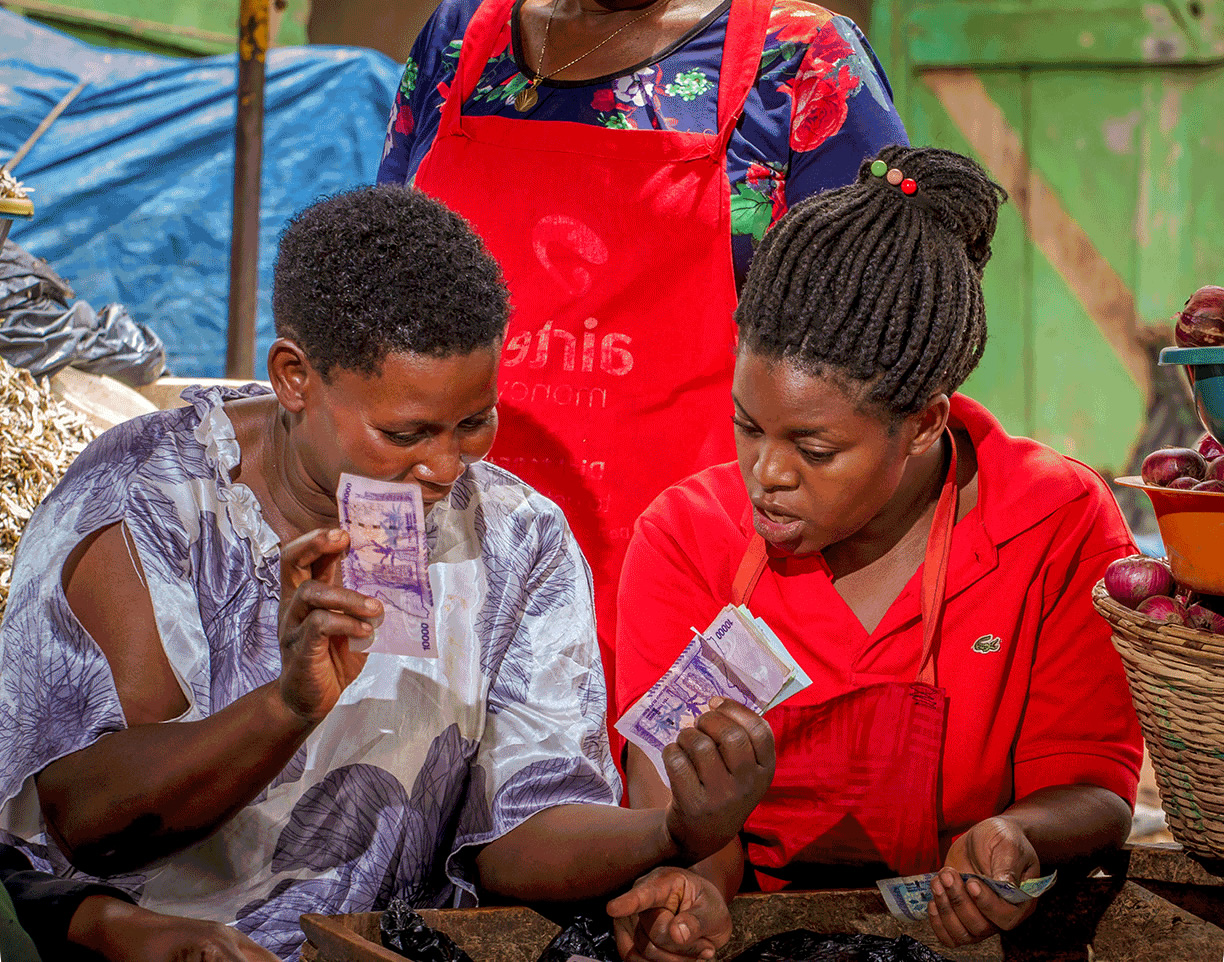
IST works to empower women and girls in the informal sector (markets) which constitutes 80% of women entrepreneurs in markets in Uganda.

From 2015 to date, we have worked tirelessly to equip 15,000 entrepreneurs (women and men) with knowledge and skills in business & financial literacy, savings, record keeping, mindset change and business diversification. 11 CBOs have been successfully formed by the trained women entrepreneurs.

The skills in business and financial management have been key drivers in enhancing their business growth through improved customer care, financial discipline in loan access, expenditure and savings and business expansion.

READ MORE
Ejit

The Market Garden App

How the Market Garden App Started

In order to empower women in the informal sector for social and economic self –reliance, the Institute for Social Transformation (IST), a women’s rights NGO in Uganda built capacity of over 10,000 market women from markets across the country in business and financial literacy.

Despite this, the market women entrepreneurs still encountered challenges and competition from mobile vendors, and an emergency of the second layer of middle men who brokerage individual/personal house hold shopping/small and medium sized enterprises shopping and make more profit.

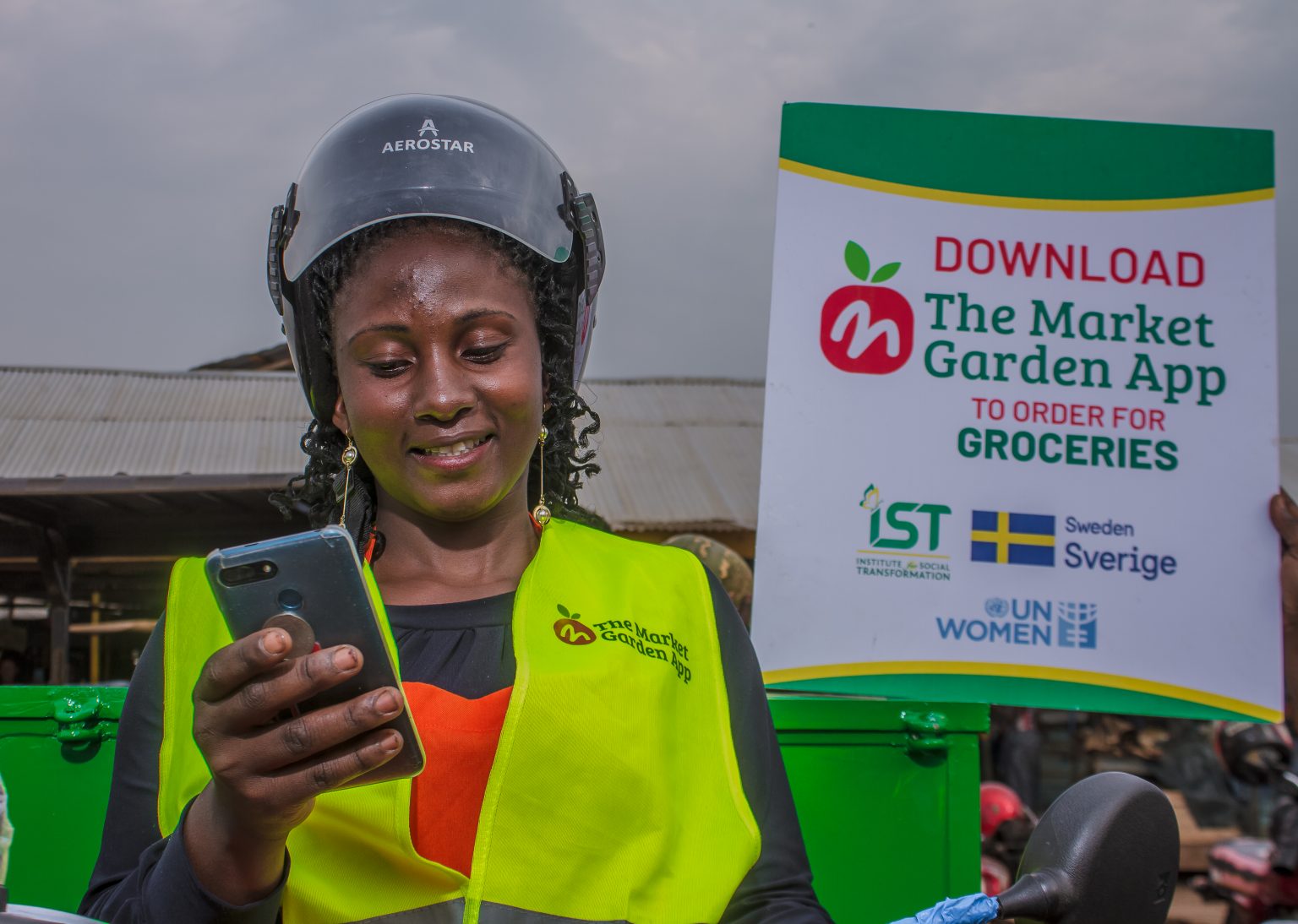
In December 2018, IST with support from UN Women and the Embassy of Sweden developed and launched the Market Garden App, an online sales platform that creates convenience for people to shop for groceries anytime, anywhere using their smartphones.

The Market Garden App went through several test runs in 2019 and was finally open for public use in March 2020. Over 1,500 orders have been processed and delivered. The App is operational in 12 markets in Kampala & Wakiso. There are over 500 women enrolled on the App. The App currently has over 1000 downloads and can be downloaded both on Google Play Store and the Apple App Store

How the App Supports Women in Markets.

Having started operations at the beginning the lockdown in Uganda, the Market Garden App has enabled the market women to rise above the effect of COVID 19 on their businesses.

The App has enabled market women in Kampala to do businesses beyond their stalls. They are able to sell their products online to virtual customers and this has led to a significant increase in their income.

The App has over 120 products which are mostly sold by the market women.

Nevertheless, there are still challenges being faced by the women especially low literacy levels and little or no access to affordable smartphones or data bundles for those with smartphones.

READ MORE
Projects

Emergency Response on COVID-19

With the outbreak of COVID-19, a global pandemic and institution of lockdowns, market communities in Uganda were categorized as essential workers who were required to sleep in markets. Though unprepared for life of living and sleeping in the market, it was welcomed by most market women as they endeavored to be at work to make money to feed their families while running their business and also adhering to the presidential directives.

The situation for most women was not desirable as the market women were facing challenges which include but are not limited to; Lack of access to safe drinking water, absence of hygiene and sanitary facilities, no bath shelters/showers making the susceptible to infections, low standards of living in the markets where they had to sleep on their stalls without beddings and exposure to bleeding mosquitoes which would eventually lead to spread of diseases like malaria.

It is with this background that IST initiated an emergency response program for markets countrywide where we supply emergency relief items in form of; handwashing facilities, sanitary towels, tents, mosquito repellants, drinking water, mattresses, blankets, handwashing soap, sanitizers, face masks and aprons. The items promote market women and men’s safety, protection and access to markets during and after the lockdowns.

READ MORE
Gtll

Transformational Leadership

We have trained over 40,000 women entrepreneurs in leadership, voice, rights and power, human and women’s rights. Majority of whom have taken on leadership at different levels; markets, local government, religious institutions and other platforms. IST boasts of having 1 woman in the current parliament of Uganda who we groomed and other 20 who have contested for leadership to represent their respective areas.

The women are organized into strong groups and associations to collectivize their voice and participate in market decision making. Through their voice and power, market women have used the media to advocate for policy changes and demanded recognition for their contribution towards the development of the economy. 

In 2017, IST established and held The National Market Women Entrepreneurs Symposium, a Forum which is held annually attracting market women from across the country to share experiences, network for women entrepreneurs to create more business opportunities and meet stake holders to front their issues for action and unveiled their importance in the economy. To date, the forum has been attended by over 3000 market women, men, leaders, government officials, development partners, ministries and the media fraternity.

READ MORE
Ejit

Cooperatives, Skilling & Revolving Fund

We have built strong cooperatives with market women in Busia, Iganga, Kampala, Wakiso, Gulu, Arua and Pader with a focus on mobilization, formation, training in co-operative formation and management, conflict management and group dynamics and mentorship in the best business practices and leadership participation for market women. Eight (8) Cooperatives have so far been formed in the 18 markets of operation and the program is yet to be rolled out to the other markets.

Under this programme, we aim to transform the working conditions of women in the informal sector operating in selected markets. We invest substantially in building coalitions and networks for women working in the informal sector, particularly market women to strengthen their positions and to give them a platform to address policy makers and local authorities collectively.

Through the Cooperative programme, the groups have been equipped with different skills; craft making, liquid soap making, briquette making, urban farming and food processing/value addition which is still on a smaller scale. The Institute also capacitates the cooperative groups with a revolving fund which is given at affordable interest rates. This fund has been used by the different groups to grow businesses but has also helped group members to network socially and emotionally. In some markets, the cooperatives are used for handling GBV cases and cases of sexual harassment.

READ MORE
Gtll

Gender Relations GBV, Conversation Circles Male Engagement

Over time, IST observed that many male entrepreneurs in market settings lack awareness of human and women’s rights gaps that contribute to the occurrence of violence against women in these spaces. In response, IST launched GBV Male Conversation Circles (trainings) piloted in markets including Nakawa, Kalerwe Bivamuntuuyo, Ntinda, Gulu Main, Cerealeno, and Lacor.

In 2016, IST with support from UN Women conducted a study on: “Women’s access to markets and the nature and extend of GBV experienced by market women.” It revealed that 71% of the market women reported that they knew at least a woman who had been abused and had their rights violated in the past one month, 57% of the market women agreed they have ever experienced violence at work in the markets and at home. This study has informed the different interventions IST has conducted in the different markets which also include; Ending Violence Against Women/Girls trainings for market leaders and market communities, conversation circles with young women in markets who are said to experience more violence and harassment in markets.

From 2023 to the present, IST partnering with WE EFFECT has scaled the initiative beyond markets, engaging both rural and urban cooperatives such as Uganda Housing Cooperative in Luweero District, Isebwe Farmers Marketing Cooperative Society Limited in Kasese District, and Nyamahasa United Area Cooperative in Kiryandongo District.

These conversation circles are designed to increase men’s awareness of human and women’s rights, aiming not only to eliminate violence against women in market environments but also to equip men with the knowledge and tools to prevent and respond to violence within their intimate relationships, families, and communities. The sessions provide a platform for men to learn from and support one another in challenging gender stereotypes, negative social norms, attitudes, and behaviors that perpetuate violence against women and girls in market settings.

To date, more than 16,500 men have benefited from the program.

READ MORE
Projects

Training for Transformation Approach

From inception, IST’s primary methodology is through Training for Transformation (TFT); envisioned to transform the mind of vulnerable women who are under gender and social oppression and marginalization, by building critical consciousness to help them take actions to change their situation. The aim of this methodology is to ensure that the oppressed need not to be oppressed forever.

It’s footprint in the East Africa region dates back to 1990s, when it was conceptualized and first initiated in Kenya and South Africa, through Catholic Churches offering group based conscientization sessions to women. Later it made its way in Uganda, with the establishment of The Institute for Social Transformation (IST) in 2006, with its training center in Busia District.

We are now building a critical mass of youth trainers in the TFT methodology who are currently undergoing the certificate course in Uganda. In addition, since working with different partners, IST has added the powerful Gender Action Learning Systems (GALS) and SASA! methodologies to its repertoire of tools to help families & communities analyze and plan their future through a process of visioning.

The Gender Action and Learning System (GALs) methodology is also a participatory approach that IST employs to integrate gender mainstreaming into its programs. It is a transformative tool designed to empower individuals especially women and marginalized groups to challenge and shift deeply rooted social norms that perpetuate gender inequalities.

GALs uses visual tools, inclusive dialogue, and collective reflection to help communities analyze and address power dynamics within households, businesses, and society at large.

READ MORE
Ejit

Functional Adult Literacy

We run a needs-based adult literacy class for market communities in Kampala and Wakiso districts in Uganda. The Adult literacy classes are conducted focusing on addressing the needs, problems, and the dreams of market women and therefore help them to learn reading, writing, counting, how to care about their health, knowing about their human rights and the laws governing them as citizens of Uganda.

The classes are conducted in both English and Luganda depending on the levels if literacy. The Adult literacy lessons conducted have not only built the ability to read, write and count but also strengthened the confidence for market women and men to speak through different platforms.

Because of these classes, IST has so far graduated a total number of 88 market women and 2 men from level 1 and level 2 of adult literacy from the three markets of Nakawa, Kalerwe Freedom and Bivamuntuuyo under the Theme “Adult literacy for improved business management”.

READ MORE
Projects

Female Urban Refugee Project

IST has also been able to appreciate and design interventions for refugee market women and vendors who by nature of their refugee status presents them more challenges compared to their Uganda counterparts. The women refugees face numerous challenges which include language barrier, lack of assets and inability to secure credit, psychological challenges, poor housing conditions and very little incomes from their informal businesses.

Poverty and the lack of livelihood opportunities within refugee households and compounds the already high level of vulnerability of the refugee women and their families to risks of exploitation, resulting in the emergence of negative coping strategies such as child marriage and transactional sex to meet basic needs for household survival.

We therefore provide integrated business and financial skills to these women including capitalization of their locally formed and owned Village, Savings and Loan Associations with cash grants. We have also trained the women in transformational leadership and GBV so that they are free from all forms of violence, own and manage small, medium and large businesses. The project has so far benefited over 500 female urban refugees whose capital has been enhanced and have been supported to formalize their enterprises.

Refugee and host community women and girls living in and around Kampala face on-going and complex GBV and protection risks in those settings due to a combination of factors, including poverty and limited livelihood opportunities, poor access to basic services and harmful socio-cultural norms.

Many women and girls are subjected to sexual violence because the slum areas where they live are GBV hot spots, or risk locations like, unlit dark streets, informal unregulated markets, in the marketplaces, at bars and/or on the way to school. This therefore calls for continued interventions to address the plight of the women.

READ MORE